
QpiAI Pro Platform Pipeline
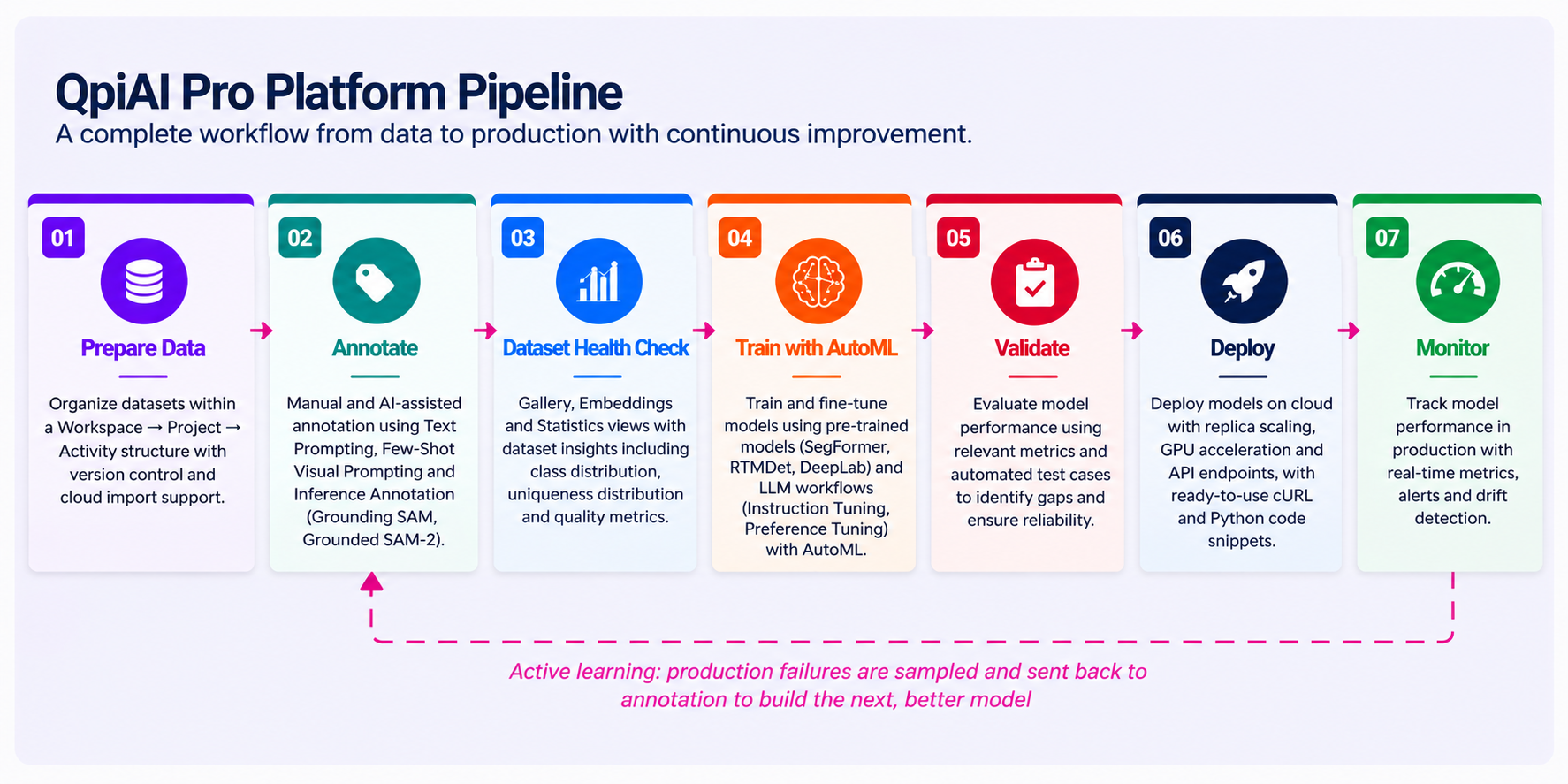
The QpiAI Pro platform provides an integrated workflow for managing datasets, annotating data, training AI models, validating performance, deploying models, and monitoring their behavior in production. The pipeline supports continuous model improvement through feedback-driven annotation and retraining.
1. Prepare Data
Organize datasets using a structured Workspace → Project → Activity hierarchy. Manage dataset versions, import data from supported sources, and reuse existing datasets where applicable. Domain and sub-domain tagging helps organize data for specific AI applications.
2. Annotate
Create labeled datasets using manual annotation and supported AI-assisted annotation methods, including Text Prompting, Few-Shot Visual Prompting, and Inference Annotation. Models such as Grounding SAM and Grounded SAM-2 can support prompt-based object detection and segmentation, reducing manual annotation effort.
3. Dataset Health Check
Analyze dataset quality and composition using Gallery, Embeddings, and Statistics views. Dataset insights, including class distribution, uniqueness distribution, and available quality metrics, help identify potential data-quality issues before model training.
4. Train with AutoML
Train and fine-tune AI models using supported pre-trained architectures and configurable training workflows. Computer vision models may include SegFormer, RTMDet, and DeepLab, while supported LLM workflows may include Instruction Tuning and Preference Tuning. Where available, AutoML can assist with hyperparameter selection and training configuration.
5. Validate
Evaluate trained models using relevant performance metrics and supported validation workflows. Automated test cases, where configured, can help identify performance gaps, model errors, and potential reliability issues before deployment.
6. Deploy
Deploy validated ML models to supported cloud environments for inference. Depending on the deployment configuration, capabilities may include GPU acceleration, replica scaling, and API endpoints for application integration. Supported integrations may provide cURL and Python usage examples.
7. Monitor
Monitor deployed models to evaluate their behavior in production. Where monitoring capabilities are configured, track inference performance, operational metrics, errors, and potential data or model drift to identify issues requiring investigation.
Continuous Improvement (Active Learning Feedback Loop)
Use relevant production failures, uncertain predictions, and other identified data gaps as candidates for review and annotation. After human validation, selected samples can be incorporated into updated datasets for model retraining, evaluation, and redeployment.
Tag and Organize: Domain and sub-domain metadata, project organization, and dataset version management support multiple stages of the pipeline. These capabilities are not necessarily separate sequential processing steps.